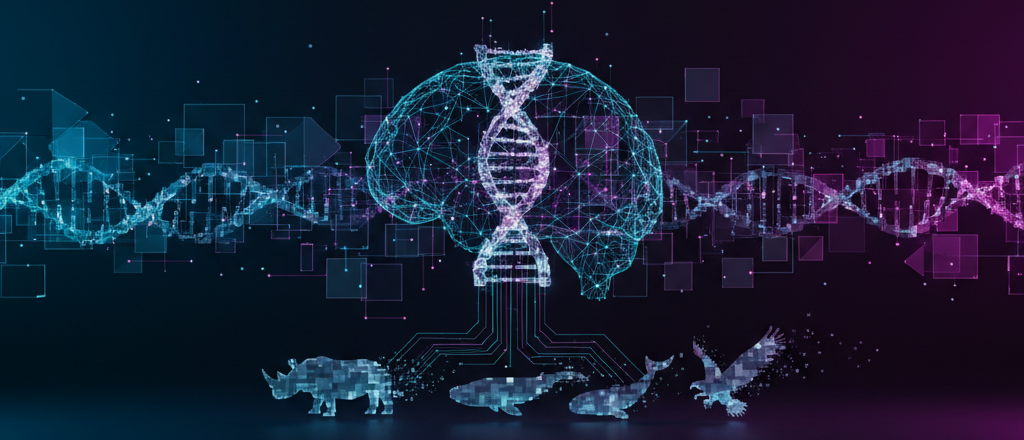
Google AI Decodes Genomes of 1.85 Million Endangered Species
- Google AI expands genetic information preservation for endangered species
- DeepPolisher reduces genome assembly errors by 50%
- Earth BioGenome Project targets 10,000 species by 2026
What Happened?
Google announced a project to preserve the genetic information of endangered species using AI.[Google Blog]
The core technologies are DeepVariant and DeepPolisher. DeepVariant is a deep learning model that identifies DNA variants, while DeepPolisher reduces genome assembly errors by 50%.[New Atlas]
These tools are being deployed for the Earth BioGenome Project (EBP). The goal is to decode 1.85 million species, with 3,000 species completed so far.[EBP]
Why Does It Matter?
Simply put, it is creating a genetic backup before extinction.
Personally, I see AI playing a decisive role here. While sequencing costs have plummeted, data analysis was the bottleneck. AI is solving this bottleneck.
EBP aims for 10,000 species by 2026. Currently processing 20 species per week, but the target requires 67 species per week.[Science]
What Comes Next?
UNEP-WCMC and Google have started analyzing wildlife trade data with AI.[UNEP-WCMC] The scope is expanding from genome preservation to illegal trade monitoring.
Frequently Asked Questions (FAQ)
Q: Can genome preservation bring back extinct species?
A: Theoretically, it opens the possibility. If genetic information is preserved, future technology could attempt restoration. However, current technology makes it difficult. The current goal is to record the genetic diversity of living species for conservation strategies. Prevention takes priority over restoration.
Q: How does DeepVariant work?
A: It converts DNA sequencing data into image-like formats and analyzes them with deep learning. It has higher variant detection accuracy than traditional statistical methods. After its 2018 release, it contributed to completing the first complete human genome. It is open-source, so any researcher can use it.
Q: Is sequencing 1.85 million species realistic?
A: It is challenging. Since starting in 2018, 3,000 species have been completed. The phase 2 goal is 150,000 species by 2030, requiring a 36x increase in weekly processing. Both AI analysis speed improvements and infrastructure innovations like portable sequencing labs are needed simultaneously.
If you found this article helpful, please subscribe to AI Digester.
References
- How we are helping preserve the genetic information of endangered species with AI – Google Blog (2026-02-02)
- How AI is sequencing the genomes of all known living species – New Atlas (2025-10-15)
- Earth BioGenome Project – EBP (2026-02-02)
- UNEP-WCMC and Google AI Partnership – UNEP-WCMC (2026-01-20)