ESP8266 Project: Turning a 4,000 Won Watch into Wi-Fi [GitHub]

ESP8266 Wi-Fi Analog Clock: Key Takeaways

  • GitHub Stars: 131
  • Languages: C++ 64.1%, C 35.9%
  • License: MIT

From a $4 Walmart Clock to an NTP Clock

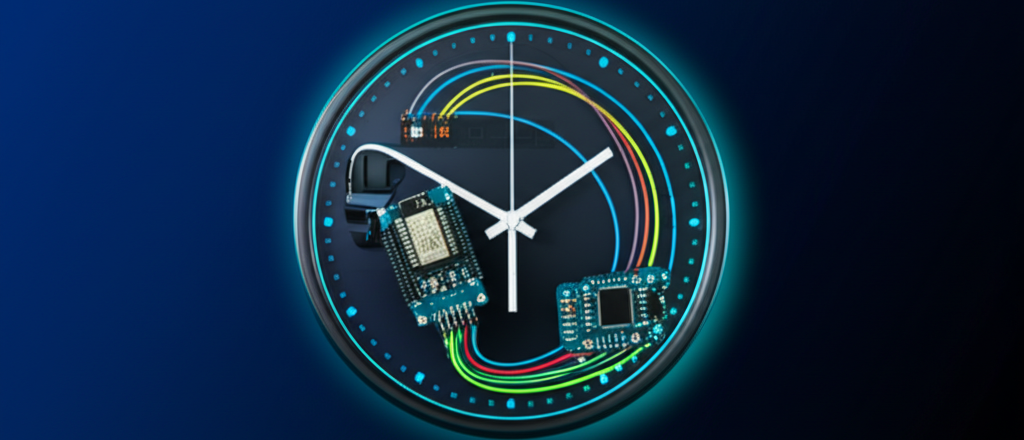
ESP8266_WiFi_Analog_Clock is a project that converts an analog clock, sold for $3.88 at Walmart, into a Wi-Fi clock.[GitHub] It uses a WEMOS D1 Mini to receive the time from an NTP server. It automatically synchronizes every 15 minutes and handles daylight saving time as well.

The ESP8266 directly controls the Lavet stepping motor inside the clock. It compares the time 10 times per second and sends a pulse to advance the second hand if it’s lagging behind.[GitHub README] Since it can’t go backward, it waits for the actual time to catch up if it’s ahead.

Remembers the Time Even When Power is Off

The key design feature is the use of Microchip 47L04 EERAM.[GitHub] With EEPROM backup in the SRAM, it doesn’t lose the hand position even during a power outage. Upon power restoration, it immediately resumes synchronization from the saved position.

Initial setup is done through a web interface. When you first power it on, you simply tell it the hand position via the web. After that, the EERAM continuously tracks the position. Status monitoring and SVG visualization are also supported on the web.

If You Want to Build It

All you need is a WEMOS D1 Mini, a 47L04 EERAM, and a cheap analog clock. Solder it on a perfboard and you’re done. It’s based on an Arduino sketch, so it’s easy to modify, and it’s MIT licensed, so you can use it freely.

Frequently Asked Questions (FAQ)

Q: How much does the entire build cost?

A: About $3.88 for the Walmart clock, $3-5 for the WEMOS D1 Mini, and about $2 for the 47L04 EERAM. The total cost of parts is roughly $10-15. You can reduce it further by recycling an existing analog clock. Soldering equipment is required separately.

Q: What happens if NTP synchronization fails?

A: Even if the NTP connection temporarily fails, the clock continues to operate. The ESP8266’s internal timer maintains the time and retries in the next cycle (15 minutes). If the internet is disconnected for a long time, errors may accumulate, but it will be corrected as soon as the connection is restored.

Q: Can I build it even if I have no programming experience?

A: You need to know basic soldering and how to use the Arduino IDE. The code is complete on GitHub, so you can just upload it as is. Basic knowledge of electronic circuits is helpful when assembling the hardware. The README is detailed, so hopefully, it will be helpful.


If you found this article useful, please subscribe to AI Digester.

References

Super Bowl 2026 AI Ads: 3 Failure Points

Super Bowl 2026 AI Ads: 3 Failure Points

  • This year’s Super Bowl saw a flood of AI-generated ads, but the response was lukewarm.
  • Brands like Artlist and Svedka actually saw negative effects.
  • Even ads that *didn’t* use AI were suspected of “AI slop.”

$10 Million for 30 Seconds, Made with AI

This year, a 30-second Super Bowl ad cost $8-10 million. In the past, high production costs meant premium quality. But this year, the flood of generative AI ads gave off a cheap vibe[The Verge].

AI video models have improved, but they’re still lacking. The problem is that multiple brands jumped in at the same time, once the tech reached a “just barely usable” level.

The Failures of Artlist and Svedka

Artlist boasted that they “made a Super Bowl ad in 5 days.” The result was a list of clips showing animals doing strange things[The Verge]. There was no story.

Svedka ran an ad with an AI robot character. The scene of the robot drinking vodka and malfunctioning looked like an AI video error[The Hollywood Reporter]. The parent company’s CMO called it “human-friendly,” but it wasn’t convincing.

An Era Where Even Non-AI Ads Are Suspect

Xfinity’s Jurassic Park ad used ILM for de-aging. But there was an outpouring of reactions calling it “AI slop”[The Verge]. The same was true for the Dunkin’ ad. The conversation focused not on the coffee, but on “Is this AI?”

This is a side effect of the AI ad deluge. Seeing awkward videos makes people reflexively suspect AI.

Frequently Asked Questions (FAQ)

Q: Which brands ran AI ads at this year’s Super Bowl?

A: Artlist and Svedka are the main examples. Artlist made theirs in 5 days, and Svedka used an AI robot character. Dunkin’ and Xfinity used traditional VFX but were suspected of using AI. Pepsi targeted Coca-Cola’s AI ads.

Q: Did AI ads reduce costs?

A: Sazerac CMO, the parent company of Svedka, admitted that AI didn’t significantly reduce costs. They said they chose AI for thematic reasons. Artlist shortened the production time to 5 days, but the quality was generally considered low.

Q: Why are even non-AI ads being suspected?

A: The backlash against generative AI has grown, so people immediately suspect AI when they see awkward visual effects. ILM and Lola VFX handled Xfinity’s de-aging, but there were “AI slop” reactions on social media. The AI ad flood itself created side effects.


If you found this helpful, please subscribe to AI Digester.

References

GitHub Outage Summary — 3rd Time in February Alone [2026]

GitHub Outage Roundup — 3rd Time in February Alone [2026]

  • February 9th: Simultaneous outages affecting Pull Requests, Actions, Copilot, and more.
  • February 2nd: Large-scale Actions outage due to Azure infrastructure issues.
  • Developer fatigue is increasing due to repeated outages within a single month.

Another GitHub Outage on February 9th

On February 9, 2026, at 16:19 (UTC), performance degradation was detected in GitHub Pull Requests[GitHub Status]. Subsequently, the impact spread to Actions, Webhooks, Issues, and Pages. Notification delivery was delayed by an average of 1 hour, and Copilot policy propagation also failed[GitHub Status].

Around 17:32, most services showed signs of recovery, but partial failures continued for Pull Requests and Copilot. Around 11 AM Eastern Time, reports of large-scale connection failures poured in[StatusGator].

Azure Was the Cause of the Actions Outage a Week Ago

There was also a large-scale outage in Actions on February 2nd. The cause was the blocking of access to the VM extension package repository due to a change in the public access settings of a storage account managed by Microsoft[Hacker News]. It lasted from 18:35 to 22:15, and Copilot Coding Agent, CodeQL, and Dependabot also stopped working.

Developer Reactions Are Lukewarm

On Hacker News, there was criticism that GitHub’s market dominance has led to a lack of investment in stability[Hacker News]. There were also complaints such as “I spent hours debugging CI failures, only to find out it was GitHub.” Although there are opinions to review alternative platforms, the cost of ecosystem transition is high, making it difficult.

Frequently Asked Questions (FAQ)

Q: Will my code disappear during a GitHub outage?

A: Git is a distributed version control system, so the entire history remains locally. Server failures do not lead to code loss. However, collaboration features such as push, pull, and PR cannot be used during an outage. Operating a separate mirror repository is safer.

Q: What happens to CI/CD during an Actions outage?

A: When Actions is interrupted, builds, tests, and deployments all stop. Workflows in the queue will restart after recovery, but may fail depending on the timeout. It is good to have a manual deployment procedure prepared as a backup.

Q: How can I check GitHub outages in real-time?

A: You can check the official status at githubstatus.com. You can also receive notifications via email or Slack webhooks. Using third-party monitoring like StatusGator together will help you identify issues more quickly.


If you found this article helpful, please subscribe to AI Digester.

References

Video AI InfiniMind [2026] Created by a Former Google Employee

Video AI Created by Ex-Google Founders: 3 Key Features

  • InfiniMind, founded by two ex-Googlers, secures $5.8 million seed funding
  • Transforms enterprise video data into searchable intelligence
  • Long-term context reasoning to track causality in hours of video

InfiniMind Targets Dark Data in Enterprise Videos

Companies produce vast amounts of video every day, from security cameras and factory monitoring to broadcast archives. Most of it is simply stored and never utilized.[TechCrunch]

InfiniMind creates an AI infrastructure that turns this dark data into structured, searchable data. CEO Aza Kai spent 9 years at Google in ML infrastructure, and COO Hiraku Yanagita led data solutions at Google Japan for 10 years.[InfiniMind]

AI That Understands Hours, Not Just 30 Seconds

The core technology is long-term context reasoning. Unlike typical video AI that analyzes in 30-second intervals, it tracks causality in hours of video. It transforms video into structured data that can be queried with SQL and supports concept-based semantic search.[InfiniMind]

$5.8 Million Seed and Product Roadmap

They received $5.8 million in seed funding led by UTEC. Headline, CX2, and Chiba Dojo also participated.[TechCrunch]

They are currently operating TVPulse, a TV broadcast analysis product, and plan to launch DeepFrame in Q2 2026. They have analyzed over 100,000 hours of video and claim to offer a quarter of the cost of existing solutions. They are also participating in the AWS Generative AI Accelerator and NVIDIA Inception.[InfiniMind]

Frequently Asked Questions (FAQ)

Q: How is it different from existing video analysis?

A: Typical video AI only looks at short segments. InfiniMind tracks causality over hours and transforms video into SQL-structured data. It also provides industry-specific analysis with concept-based search and domain-specific adapters.

Q: Who are the main customers?

A: The target is media/broadcasters, retail, security/defense, and logistics/manufacturing. Broadcasters use it for archive search, manufacturers for defect detection, and retailers for store analysis.

Q: What about data security?

A: It supports VPC and air-gap deployment. It can operate independently within the company’s internal infrastructure, eliminating concerns about video data leakage. It is a structure suitable for companies that value data sovereignty.


If you found this helpful, please subscribe to AI Digester.

References

Longest Visible Distance on Earth, 530km, Found by Rust Algorithm [2026]

The Farthest View on Earth, Found by an Algorithm

  • 530km between Hindu Kush and Peak Dankova confirmed as the longest line of sight on Earth
  • CacheTVS algorithm based on Rust calculated 4.5 billion lines of sight
  • Global analysis completed in 18 hours with 5 AMD Turin servers

530km, from Kyrgyzstan to China

The CacheTVS algorithm, created by developers Ryan Berger and Tom Buckley-Houston, calculated the visibility range of every point on Earth.[All The Views] The longest line of sight was confirmed to be 530km from Peak Dankova in Kyrgyzstan to the Hindu Kush mountain range in China.

Second place was 504km from Antioquia, Colombia to Pico Cristobal, and third place was 483km from Mount Elbrus, Russia to Pontus, Turkey.[Ryan Berger’s Blog]

Cache Efficiency Was Key

The core of CacheTVS is cache optimization. The existing method had a cache miss rate of 96%. This was solved by rotating the terrain data and arranging it contiguously in memory.[GitHub]

By adding AVX-512 SIMD and multithreading, the calculation time for Mount Everest was reduced from 12 hours to 2 minutes. This is 160 times faster than existing GPUs.[Ryan Berger’s Blog]

Analyzing the Entire Earth for Hundreds of Dollars

The entire Earth was analyzed with hundreds of AMD Turin cores and hundreds of GB of RAM. The cost was in the hundreds of dollars, a dramatic reduction from the initial estimate of hundreds of thousands of dollars.

2,500 tiles were processed with 100m resolution terrain data, and the results were released as an interactive map.[All The Views] On Hacker News, ideas for applications such as wireless communication and mesh networks poured out.[Hacker News]

Frequently Asked Questions (FAQ)

Q: Can you actually see 530km?

A: Theoretically possible, but atmospheric conditions must be perfect. The Guinness World Record for the longest actual photograph is 483km, and was only possible under special conditions with favorable atmospheric refraction. It is virtually impossible in normal weather.

Q: Does it consider the curvature of the Earth?

A: Yes. The curvature of the Earth and atmospheric refraction are included in the correction formula. The refraction coefficient is set to 0.13 to reflect the effect of light bending as it passes through the atmosphere. Without this correction, there would be large errors in long-distance calculations.

Q: Where can it be used?

A: It can be used for communication tower placement, wireless communication path planning, mesh network optimization, and visual impact assessment of wind power generation. You can check the visibility range of a specific point on the interactive map, which is helpful for planning hiking or filming.


If you found this article helpful, please subscribe to AI Digester.

References

3 Siemens AI Automation Strategies — From Digital Twins to PepsiCo’s Performance [2026]

Siemens CEO’s 3 Key Strategies for AI Automation

  • Build factories virtually first with Digital Twin Composer
  • Partner with NVIDIA to build an industrial AI operating system
  • PepsiCo increased production by 20% with this technology

Siemens Declares: Automate Everything

Siemens CEO Roland Busch unveiled an ambitious vision at CES 2026: embedding AI into every process from design to operation. The key weapon? The ‘Digital Twin Composer’.[Siemens Blog]

Before building a real factory, simulate the process with photorealistic 3D models in a virtual space. By connecting to real-time sensor data, up to 90% of issues can be caught in advance during the pre-production stage.[Siemens Tecnomatix]

Industrial AI Operating System Created with NVIDIA

Siemens has expanded its partnership with NVIDIA to announce an ‘Industrial AI Operating System’. This is an integrated platform combining NVIDIA’s accelerated computing with Siemens’ industrial software.[IIoT World]

Busch stated, “Industrial AI is no longer a feature, but a force that will reshape the next century.” The direction is to evolve from automation to autonomy, and from digital twins to ‘decision-making twins’.

Real Results Proven by PepsiCo

The results of PepsiCo’s adoption of the Digital Twin Composer are impressive. They achieved a 20% increase in production, nearly 100% accuracy in design verification, and a 10-15% reduction in capital expenditure.[Siemens Blog]

According to PepsiCo, “Work that used to take months has been reduced to days.” This means that the method of building virtually first and then building faster in reality actually works.

Frequently Asked Questions (FAQ)

Q: What is Digital Twin Composer?

A: It’s a solution announced by Siemens at CES 2026. It creates and simulates 3D models in a virtual environment before actual factory construction. It integrates design, real-time data, and AI to proactively identify and optimize problems.

Q: How is the Industrial AI Operating System different from existing automation?

A: While existing automation was about replacing repetitive tasks with machines, this system allows AI to make its own judgments and optimize. The difference lies in the intelligent automation of the entire process by combining NVIDIA’s computing power with Siemens’ domain expertise.

Q: Will this affect general businesses?

A: It impacts not only manufacturing but also industries connected to the physical world such as energy, infrastructure, and automotive. The method of reducing facility investment and increasing productivity through virtual simulation can be applied regardless of scale.


If you found this article useful, please subscribe to AI Digester.

References

TechCrunch Founder Summit 2026, Call for Speakers Begins [2026]

TechCrunch Founder Summit 2026: 3 Key Takeaways

  • A large-scale startup event in Boston on June 23rd, with over 1,100 attendees.
  • Focuses on practical conversations in a 30-minute roundtable format, without slides.
  • Speaker applications are open for founders, VCs, and startup operators.

1,100-Person Startup Event in Boston

TechCrunch is recruiting speakers for the 2026 Founder Summit. The event will be held in Boston on June 23rd and is expected to be attended by over 1,100 founders and investors.[TechCrunch]

This event, which addresses the realities of scaling startups, is known for its practical discussions every year. This year, experienced founders, venture capitalists, and startup operators will gather to share challenges at each stage of growth.[TechCrunch]

30-Minute Roundtable Without Slides

The core format of this summit is the roundtable. Each session consists of a 30-minute informal discussion led by up to two speakers. It proceeds purely through conversation, without slides or videos.[TechCrunch]

The focus on conversation rather than presentation is noteworthy, especially in the AI startup ecosystem. The recent rapid growth of AI-based startups has complicated scaling challenges. This makes a forum for sharing real-world experiences even more valuable.

A Meaningful Opportunity for AI Startups

For founders in the AI field, this summit is an opportunity to meet investors and gain scaling know-how. The scale of over 1,100 attendees is significant from a networking perspective. Participating as a speaker provides a great platform to promote your company’s technology and experience.

Interested founders can submit a speaker application on the official TechCrunch website. The specific deadline has not yet been announced, so early application is advantageous.[TechCrunch]

Frequently Asked Questions (FAQ)

Q: When and where will the TechCrunch Founder Summit 2026 be held?

A: It will be held in Boston, USA, on June 23, 2026. It’s a large-scale startup event with over 1,100 founders and investors attending, featuring practical discussions on scaling. The core format is informal roundtable discussions, with startups from various stages of growth participating.

Q: What are the requirements to apply as a speaker?

A: Founders, venture capitalists, and startup operators with actual startup scaling experience are eligible. You can apply through the speaker application portal on the official TechCrunch website, and the specific deadline has not yet been announced. Sharing insights based on practical experience is key.

Q: What is the format of the roundtable sessions?

A: It’s a 30-minute informal discussion led by up to two speakers. It proceeds purely through conversation, without slides or video presentations, and the goal is to share practical insights through meaningful dialogue with attendees.


If you found this helpful, please subscribe to AI Digester.

References

TSMC to Produce 3nm AI Semiconductors in Japan [2026]

TSMC to Produce 3nm AI Chips in Japan — Kumamoto Plant Plan Changes

  • TSMC will produce 3nm semiconductors at its second Kumamoto plant.
  • This is a change from the original 6-7nm plan, driven by the surge in AI demand.
  • The Japanese government will provide subsidies of up to 1.2 trillion yen.

Kumamoto’s Second Plant Upgraded to 3nm

On February 5th, TSMC announced that it would produce 3nm semiconductors at its second plant in Kumamoto Prefecture, Japan. Originally, the plan was to manufacture only 6-7nm chips. The plan was changed due to the explosive increase in AI demand.[Nikkei Asia]

After temporarily halting construction at the end of last year, the plant entered a redesign phase to install advanced equipment. 3nm is currently the most advanced process available for mass production. It’s a core technology supplied to companies like Nvidia and Apple.[AP통신]

Japan’s Semiconductor Economic Security Strategy

Prime Minister Sanae Takaichi assessed this decision as “highly significant from an economic security perspective.” The Japanese government has pledged subsidies of up to 1.2 trillion yen (approximately $7.9 billion) for the two TSMC plants.[Washington Post]

Sony, Denso, and Toyota are participating in TSMC’s Japanese subsidiary (JASM). This is a strategy to reduce the risk of concentration in Taiwan and to shorten the distance between customers and the supply chain.

AI Chip Demand and TSMC’s Expanded Investment

TSMC has set its capital expenditure for 2026 at $52 billion to $56 billion, an increase of approximately 40% compared to the previous year. In the fourth quarter of 2025, revenue reached $33.73 billion and net profit reached $15.2 billion, representing growth of 20.5% and 35%, respectively.[AP통신]

Chairman Wei Zhejia dismissed concerns about a bubble, saying that “customer AI demand is real.” Processes of 7nm and below account for 77% of wafer revenue.

Frequently Asked Questions (FAQ)

Q: When will TSMC’s second Kumamoto plant be operational?

A: The exact timing is undisclosed. Construction is scheduled to begin in the fall of 2025, and the plant is being redesigned for 3nm equipment. TSMC’s Arizona plant in the United States is scheduled to begin 3nm production in 2027, so the timing may be similar. The Japanese government is also strengthening subsidy support to accelerate operations.

Q: How are 3nm semiconductors different from existing chips?

A: The smaller the nanometer, the more transistors can be packed densely. 3nm is currently the highest level available for mass production. It processes more calculations in the same area and improves power efficiency. This is a core process for AI model training and inference.

Q: Why is Japan attracting TSMC?

A: Japan’s semiconductor manufacturing capabilities have weakened since the 1990s. It aims to strengthen economic security by producing advanced chips domestically. It also aims to prepare for risks in the Taiwan Strait and establish a stable chip supply chain for companies such as Sony and Toyota.


If you found this article helpful, please subscribe to AI Digester.

References

Galaxy S26 vs iPhone 18 Pro: EdgeFusion AI Feature Comparison, Is it a Real Game Changer?

The biggest battleground in the 2026 smartphone market is AI. The Samsung Galaxy S26 series and the Apple iPhone 18 Pro are poised for a head-on collision, each touting its own on-device AI strategy. In particular, there’s a lot of buzz around whether Samsung’s newly introduced EdgeFusion architecture can actually be a game-changer.

Samsung is rumored to be equipping the Galaxy S26 Ultra with its own EdgeFusion AI engine. According to a TechTimes report, EdgeFusion significantly reduces cloud dependency and runs large language models directly on the device. This is said to enable real-time translation, document summarization, and even image generation in offline environments. Sammy Fans reports that the Galaxy S26’s AI image generation feature has reached a level where it can create high-resolution images from text prompts alone.

On the other hand, Apple is expected to further enhance Apple Intelligence in the iPhone 18 Pro. Tom’s Guide compares the two devices, analyzing that Apple has taken an approach of deeply integrating AI throughout the system, while Samsung is focusing on maximizing the performance of individual AI functions. Apple’s strength lies in its ecosystem integration. The seamless AI experience that connects to Macs, iPads, and Apple Watches is something that Samsung will find difficult to catch up with.

There are also differences in price and specs. According to a comparative analysis by Sammy Fans, the Galaxy S26 Ultra has a larger battery and higher RAM, showing a hardware configuration that is advantageous for AI calculations. However, it remains to be seen after launch whether the difference in hardware specs will be noticeable in actual use.

For EdgeFusion to be a true game-changer, it needs to go beyond simply listing features. Offline AI processing speed, battery consumption, and integration with third-party apps are key. The direction of the AI smartphone era will be determined when both products are released in the second half of 2026. From a consumer’s perspective, it is wise to carefully consider the practical usability of AI functions in either case.

FAQ

Q: How is EdgeFusion AI different from existing Galaxy AI?

A: EdgeFusion is an architecture that runs large AI models on the device itself without the cloud. Previously, complex tasks had to be sent to a server, but EdgeFusion can handle advanced functions such as translation and image generation even offline.

Q: Compared to Apple Intelligence on the iPhone 18 Pro, which is more advantageous?

A: Samsung excels in the performance of individual AI functions, while Apple has strengths in ecosystem integration between devices. Samsung is likely to have an advantage in single-device AI performance, while Apple is likely to have an advantage in multi-device AI experience.

Q: Is the AI image generation function of the Galaxy S26 Ultra practical?

A: It can generate high-resolution images from text prompts alone, making it useful for creating SNS content or simple design work. However, it is difficult to completely replace professional design tools, and its value as an auxiliary tool is greater.

OpenClaw AI Agent, Changing the Landscape of Messaging, Transactions, and Email Automation

OpenClaw is an open-source AI agent that integrates messaging, transactions, and email processing into one. Evolving from Clawdbot to Moltbot, this tool has garnered significant attention and controversy worldwide since its release. It’s being hailed as a ‘super agent’ that goes beyond simple chatbots to autonomously perform actual tasks.

The core of OpenClaw is vertical integration. Previously, messaging automation, payment processing, and email management had to be handled with separate tools. OpenClaw allows a single agent to handle all these functions continuously while maintaining context. For example, upon receiving a customer inquiry, it can analyze the content, look up relevant transaction history, and even complete the refund process without human intervention. IBM has analyzed that this vertical integration approach showcases the future of enterprise workflows. Thanks to its open-source release, it’s rapidly spreading within the developer community, even spawning a derivative project called Moltbook. According to CNBC, OpenClaw is creating both excitement and fear, as the potential for misuse exists with an AI that autonomously executes financial transactions. In fact, the security industry is already on high alert. CrowdStrike warns that security teams need to closely monitor OpenClaw’s API access permissions and execution scope. Scenarios such as automated phishing email sending or unauthorized transaction execution are of particular concern.

OpenClaw marks a turning point where AI agents transition from simple auxiliary tools to actual task executors. Balancing convenience and security will be a key challenge. Companies would be wise to establish access control and auditing systems before adoption. The self-correcting actions of the open-source ecosystem and regulatory discussions will likely determine the direction of this technology.

FAQ

Q: What tasks can OpenClaw automate?

A: Messaging responses, email classification and replies, and transaction processing such as payments and refunds are handled integrally by a single agent. Continuous processing is possible while maintaining context between each task.

Q: What are the security risks of OpenClaw?

A: The autonomous transaction execution and email sending capabilities can be misused. CrowdStrike recommends managing API permissions and limiting the execution scope. An audit log system is essential upon adoption.

Q: What is the difference from existing automation tools?

A: Existing tools process messaging, transactions, and emails separately. The key differentiator is that OpenClaw vertically integrates these into a single agent, seamlessly automating the entire workflow.